Land Holds Memory, People Hold Longing, Language Holds Feeling, and Between Them Rises a State That Makes a Homeland
Four things called a homeland. Four elements that seem far apart, yet when they come together they make a single word: Saudi Arabia.
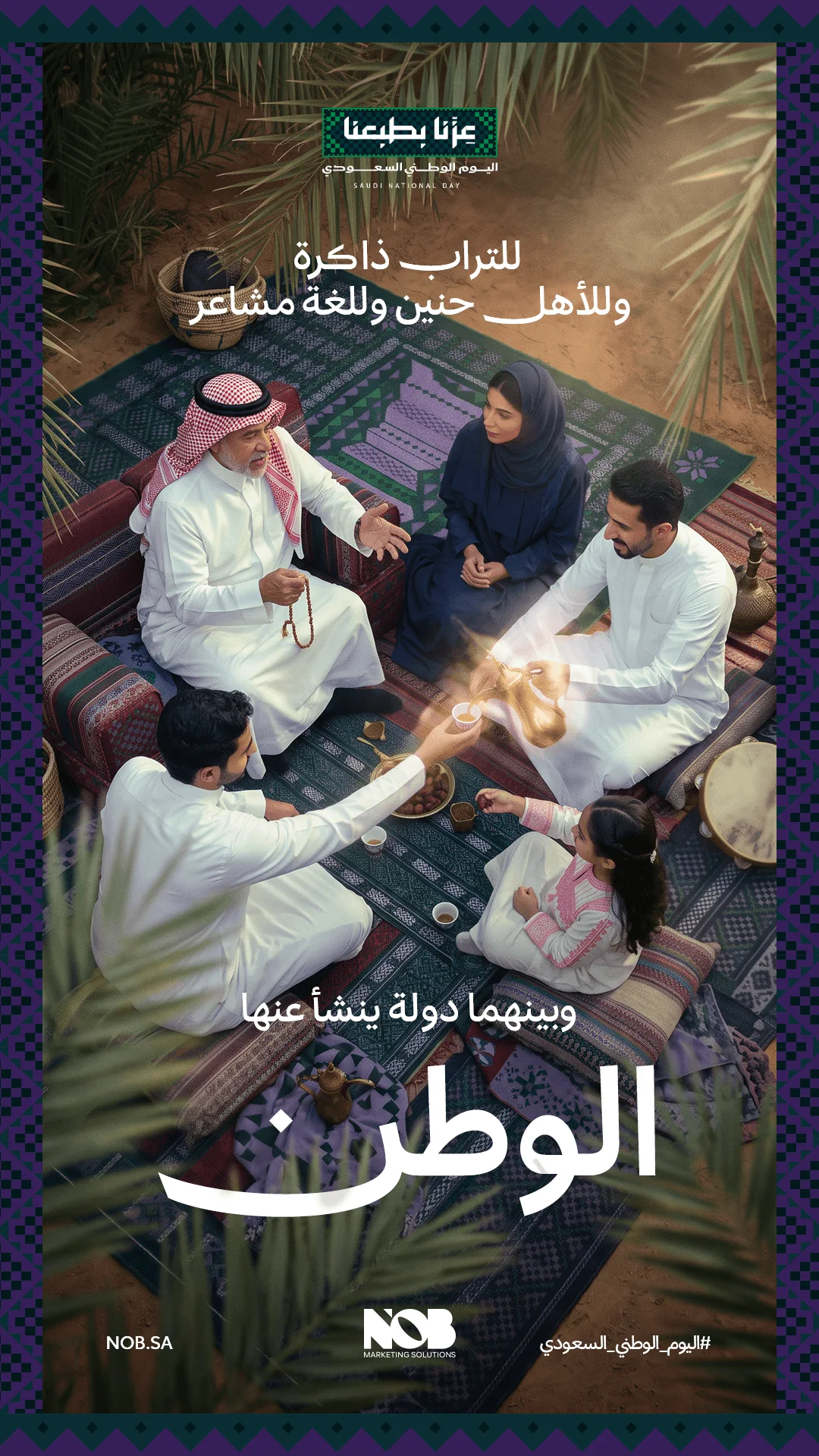
Four things called a homeland
On maps, a homeland looks like a space bounded by lines. In books of politics, it is a state with a name, a flag and sovereignty. In family records, it is faces, names and memories. And on the tongue, it is the words by which we recognise one another, even if we meet at the far end of the earth.
But a homeland is too big to be summed up by a map, and too close to be contained by a definition.
On Saudi National Day, as flags fill the streets and cities dress in green, perhaps the question is a different one this time:
What is a homeland made of?
Four things may be enough to answer:
Land, a state, people and a language. Four elements that seem far apart, yet when they come together they make a single word: Saudi Arabia.
The land | Where the story began
Before the state, there was the land.
There was the desert in its long reach, the mountains with their peaks, the valleys with their passes, the oases with their palms, and the two seas that open the place onto the world through two windows.
On this geography the Saudi story was lived long before it carried its modern name.
From Najd and its plateaus to the Sarawat mountains, from the sands of the Empty Quarter to the oases of Al-Ahsa, from the shores of the Red Sea to the Arabian Gulf, Saudi Arabia is not a geography of a single colour.
Every region has its own face.
In the south, farming terraces cling to the mountains. In the east, palms, water and the Gulf. In the west, sea, mountains and cities that for centuries carried the footsteps of those coming to Makkah and Madinah. In the north, deserts and inscriptions telling of travellers who passed hundreds and thousands of years before us. And in the centre, the land from which the story of the state set out.
At the heart of this geography stands Diriyah: not merely an old place left over from the past, but a witness in stone to the beginning of a political story that has spanned centuries.
Land here is not just grains of sand.
It is the grandfather's house, the father's farm, the neighbourhood where the children grew up, the road you know without asking its name, the mountain the people of a city see as part of its features, and the sea bound up with the livelihoods and memories of the coast.
That is why, when we say “the land of the homeland”, we are not describing geographic ownership alone, but a person's bond with a place.
Today, as cities expand, new projects are born and parts of the Saudi landscape are reshaped, the land returns to the equation of the future: in protecting the environment, growing green cover, nature reserves, reviving historic sites and restoring the bond between development and place.
A country can build something new on its land every day, but it knows that some things must not be lost beneath the buildings: the memory of the land.
On National Day we do not celebrate the land because it is an area on a map, but because it is the first stage on which the story unfolded.
Yet the land, however vast, needs something to hold its edges together.
And here the second element begins.
The state | When the land took one name
The land had been there for thousands of years, but the modern moment of the homeland came when this geography took one name, one banner and one state.
On 5 Shawwal 1319 AH, 15 January 1902, King Abdulaziz bin Abdulrahman Al Saud entered Riyadh, opening a new chapter in a long journey that ended with the unification of the country.
The distances were not easy.
What we see on the map today as a single whole was, in those days, vast deserts, long roads, scattered communities and regions kept apart by geography and the hardship of travel.
As the stages of unification followed one another, the map changed, until in 1932 the royal decree unified the country and named it the Kingdom of Saudi Arabia, and 23 September became the date on which, every year, we recall the moment the name was complete.
From that day on, the story of the state was no longer a story of borders alone.
Another journey began: building what lies within the borders.
Institutions were founded, roads were laid, education spread, health services grew, electricity, water and communication networks arrived, small towns became great cities, and roads and airports connected the corners of a country where the distance between places had once been an arduous journey.
The reigns of the Kingdom's kings followed one another, and in each era the state added a new layer to what it was building.
Until Saudi Arabia reached a time when ambition was no longer limited to meeting the needs of development, but moved on to reshaping the economy, the cities, the way of life and the Kingdom's place in the world.
With Saudi Vision 2030, the country entered another chapter of the story: a more diverse economy, giga-projects, investment in technology, tourism, culture, sport and industry, and a growing Saudi presence at the political and economic table of the world.
Between the Riyadh that King Abdulaziz regained at the start of the twentieth century and the Riyadh of today, a city preparing to host the world at major international events, lies a span of time that is short in the life of nations, but immense in the scale of the change.
And yet one of the state's quietest achievements is the one that least needs pictures:
That people feel safe within it.
The state is not the ministry buildings, the regulations or the projects alone; it is the feeling that behind the details of daily life stands an entity that protects the land, orders life and carries everyone's name.
That is why National Day marks the founding of the homeland's political meaning as much as it celebrates its achievements.
But a state, however strong, remains institutions and borders if it lacks its most living element: the people.
The people | A homeland that walks on two feet
You can know Saudi Arabia by its flag... but you can also know it by its people.
By a majlis where coffee cups are passed around, by a door opened to a guest, by a table whose dishes change every few hundred kilometres, and by a dialect that sometimes tells you someone's city before they tell you their name.
Here the homeland becomes a person.
The Saudi Arabia that the state unified did not erase the differences between its regions; it carried those differences with it.
In the Hijaz, a culture shaped by centuries of welcoming people from every corner of the earth. In Najd, social customs woven by life in the heart of the Peninsula. In the south, colours, chants, architecture and customs of their own. In the east, a culture tied to the oases, the sea and trade. In the north, traditions shaped by the desert and the old crossing routes.
Even the clothes are not the same... nor the food... nor the chants... nor the dialects.
But when National Day comes, it is as if all those details had been rehearsing all year for a single scene: one flag above different homes.
This may be one of the most beautiful images of the homeland: that there are many ways of living Saudi Arabia, while the Saudi Arabia we belong to remains one.
And the people are not only a folkloric picture of the past.
They are also the ones who make the country's present every morning.
The soldier on the border, the doctor in the hospital, the teacher in front of the class, the engineer on site, the farmer in the field, the employee at the desk, the entrepreneur starting an idea from nothing, and the young men and women carrying ambitions that may not have been possible for the generations before them.
Not all of them appear in the pictures of National Day.
But they are the homeland on all its other days.
Belonging is not measured only by the number of flags raised in September, but by what people do for this land for the rest of the year.
If the land gives the homeland its place, and the state gives it its being, then the people give it what no map or system can:
Its soul.
A country does not become a homeland because its borders are well drawn, but because behind those borders are people who share a memory and a destiny, and who can look at one another and say:
We are from here. But how do we recognise one another? Sometimes a single word is all it takes.
The language | The homeland we travel with
A person may leave their city, and may travel thousands of kilometres from their country, but something of the homeland always leaves with them:
Their language.
In a faraway airport, you may hear a Saudi word behind you and turn around without thinking.
You did not see the speaker, nor ask where they came from, but a small tone or a single word was enough to shrink the thousands of kilometres between you and home.
Language is not just a tool for speaking.
It is a memory you carry.
Arabic in Saudi Arabia carries a meaning beyond being the official language of the state: this country is home to the Two Holy Mosques, and through it millions of Muslims connect with the language in which the Holy Quran was revealed.
Across the Kingdom, geography has made another mosaic within Arabic: of dialects and words.
There are words the people of the south know best, others that live in the majlises of Najd, and words from the Hijaz, the east and the north; a Saudi ear can often place a city or a region from the tone of a single sentence.
These dialects do not divide the identity; they enrich it.
Just as the homeland's landscapes differ while it remains one homeland, its people's tongues differ within a language that brings them together.
Language also keeps the names of things; the things themselves may disappear while their names remain.
The names of villages, valleys and mountains, of the grandparents' tools, of foods and clothes, of the winds and the rain, the camels, the palms and the sea.
Each of these words is a small store of the memory of a place.
Then comes poetry.
From classical verse to Nabati poetry, from the Saudi Ardah to folk chants and national songs, Saudis have always told of their bond with their land in words.
The medium changed...
Poetry was recited in the majlis, then came radio and television, and today a poem, a song or a national phrase reaches millions of people in seconds through a small phone.
But the new medium has not changed the old need:
To say something about the homeland.
Perhaps that is why language is the most remarkable of the homeland's four elements: we cannot carry the land with us, the state's borders end where the maps do, and distance may separate us from our people; but language can cross borders with us.
And when a Saudi is thousands of kilometres from home, a single word in their own dialect may be enough to bring them back.
Sometimes, language is the shortest road home.
When the four come together
On National Day, you can look at Saudi Arabia from the sky.
You will see a vast expanse stretching between two seas, crossed by mountains, deserts, cities and villages.
That is the land.
You can look at the map and see borders around that expanse, a green flag and one political name.
That is the state.
Then come down to the streets.
You will find millions of people, different in the features of their regions, their dialects and their customs, yet raising the same flag.
Those are the people.
Then fall silent for a moment.
You will hear Arabic, in its eloquence and its dialects, in people's conversations, their songs, their poems and their chants.
That is the language.
Perhaps this is why a homeland is hard to define in a single sentence.
Because it is not only something we see, nor a history we read, nor a place we live in.
It is many things gathering inside a person without their noticing.
Land that gives them a place.
A state that gives them a being.
People who give them a soul.
And a language that gives them a voice.
The 96th National Day
On 23 September every year, Saudi Arabia does not simply celebrate another year since its unification.
It recalls that old equation:
A land that became a state,
a state that brought a people together,
and a people who spoke in one language about something they all loved.
And summed up the four things in a single word: